




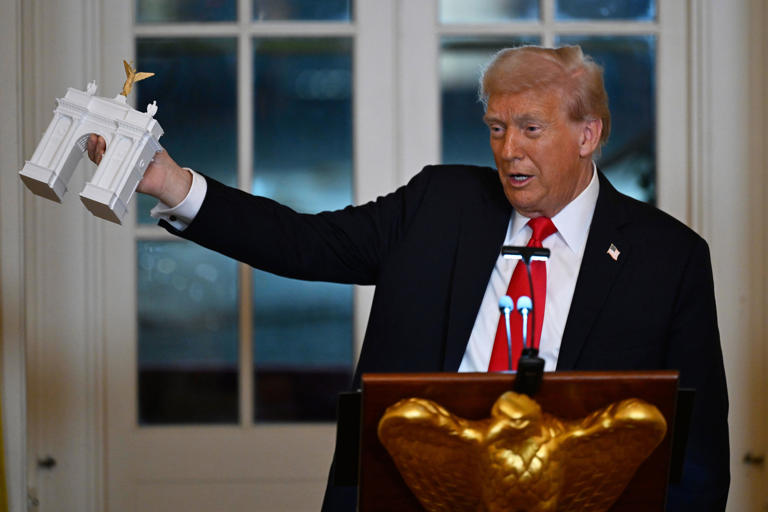
President Donald Trump says his long-promised “Triumphal Arch” could finally move from model to construction site within the next two months — a timeline that would put ground-breaking on a massive, politically charged monument ahead of July 4, 2026, when the United States marks its 250th anniversary.

Trump made the claim in a phone interview from Mar-a-Lago, telling POLITICO the project has not started yet but will begin “sometime in the next two months,” adding that “everyone loves it.” The comment lands as the White House and affiliated groups ramp up semiquincentennial planning across the country — and as critics accuse Trump of turning a national commemoration into a personal branding exercise.
For ongoing coverage and analysis, follow updates at BrandonBent.com, and see the official commission framework at America250.
Trump Triumphal Arch timeline and what he’s claiming
In Trump’s telling, the Trump Triumphal Arch is both inevitable and wildly popular. He has compared it to Europe’s victory monuments — a sweeping, classical gateway meant to convey permanence, strength, and national pride — while repeatedly insisting it will “honor American history and military service.”
But his offhand certainty obscures basic questions that typically govern major construction in Washington, D.C.: Which federal agencies have signed off? What design has been finalized? What budget has been approved? And what legal authority is being used to build a new monument near the National Mall?
Those questions matter because monument projects in federally protected spaces usually require extensive review, environmental and historic preservation assessments, and — crucially — congressional authorization. Trump’s latest two-month timeline is already being interpreted by opponents as an attempt to force momentum before the public can see costs, renderings, or permitting details.
Where the arch could go — and why location is the fight
Plans discussed publicly have placed the arch near the Lincoln Memorial and the Arlington Memorial Bridge corridor leading toward Arlington National Cemetery. The symbolic intent is obvious: the structure would sit within one of the most photographed, historically weighty zones in the capital, adjacent to a civic landscape designed to project national memory and democratic ideals.
That same symbolism is why the proposal is controversial. Critics argue that dropping a Paris-inspired “victory” monument into the Mall’s western axis risks distorting the National Mall’s historical narrative — shifting it away from commemoration and toward triumphal spectacle. Preservation advocates also warn that new permanent construction could disrupt sightlines, traffic patterns, and protected parkland in an area already under intense management constraints.
Cost, authority, and the ethics of building it “because I want it”
Even supporters of an ambitious semiquincentennial celebration have questioned the process. The central issue is not whether the United States can host big events for its 250th birthday — it can — but whether one president can treat Washington’s monumental core as a personal canvas without clear democratic consent.
Trump’s approach has been to frame objections as elite nitpicking: aesthetics, paperwork, and “bureaucracy.” Yet those “paperwork” steps are how the public learns what will be built, who pays for it, how much it costs, and what tradeoffs come with construction on federal land. Without transparency, the Triumphal Arch becomes less a patriotic marker and more a test of how far executive power can stretch when no one stops it.
At minimum, opponents argue the project should be debated openly with congressional oversight. At maximum, they argue it should be rejected outright as a monument to ego: a structure that feels less like national history and more like a physical embodiment of Trump’s political style — grand, theatrical, and indifferent to institutional limits.
The 250th anniversary becomes a stage for spectacle
The Triumphal Arch proposal is only one piece of a broader pattern: Trump has repeatedly promoted high-profile, attention-dominating initiatives connected to America’s 250th — initiatives that often place him at the center of the story. That includes a separate push for flashy events and branding-friendly imagery that can travel easily on social media and in campaign-style messaging.
In that same POLITICO conversation, Trump also hyped a proposed UFC event on White House grounds. He suggested the showcase could feature “many matches, like 10,” and praised UFC President Dana White — a longtime ally — as the person who will choose fighters. The message is consistent: the semiquincentennial is not merely an anniversary, but an entertainment product, with Trump as the executive producer.
Supporters may see that as modernizing patriotic celebration. Critics see something else: the conversion of the White House into a branding platform — a place where a president’s personal relationships, preferred aesthetics, and commercial-adjacent spectacles blur the line between national institutions and political theater.
What the Trump Triumphal Arch fight reveals about power
At its core, the Trump Triumphal Arch controversy is about governance. A major new monument near the National Mall is not a normal infrastructure project. It’s a permanent alteration of the country’s civic “front yard,” the symbolic heart of the republic. Decisions about that space traditionally move slowly for a reason: they are supposed to outlast any single administration.
Trump’s insistence that construction will begin within two months appears designed to create a fait accompli — to establish physical progress before lawmakers, preservation agencies, and the public can force a deeper debate. If heavy equipment arrives and foundations are poured, stopping the project becomes politically and financially harder, even if approvals were shaky or incomplete.
That tactic — move fast, dare institutions to stop you — has become a hallmark of Trump-era governance. It relies on fatigue, confusion, and the assumption that the “rules” are flexible if the president wants something badly enough.
What Happens Next?
If Trump’s two-month prediction holds, the next immediate flashpoints will be permits, site preparation, and funding clarity. Watch for public signals from agencies responsible for the National Mall corridor, as well as any congressional response challenging the executive branch’s ability to proceed unilaterally.
For the White House, the political incentive is obvious: break ground early, claim momentum, and roll the imagery into the lead-up to the 250th anniversary — an American milestone that should belong to the country, not to one politician’s vanity project.
For the public, the question is simpler. If the United States is going to mark its 250th birthday with new national symbols, who decides what those symbols are — and do Americans get a real say before concrete is poured?
Sources
- Newsweek — Donald Trump Shares Major Update on New DC Monument
- Fox News — Trump says Triumphal Arch construction to begin within 2 months
- Le Monde — Trump takes the lead as the US celebrates 250 years of independence
- Sports Business Journal — UFC’s road to the White House built through highs and lows
- Wikimedia Commons — Lincoln Memorial photo (featured image)