



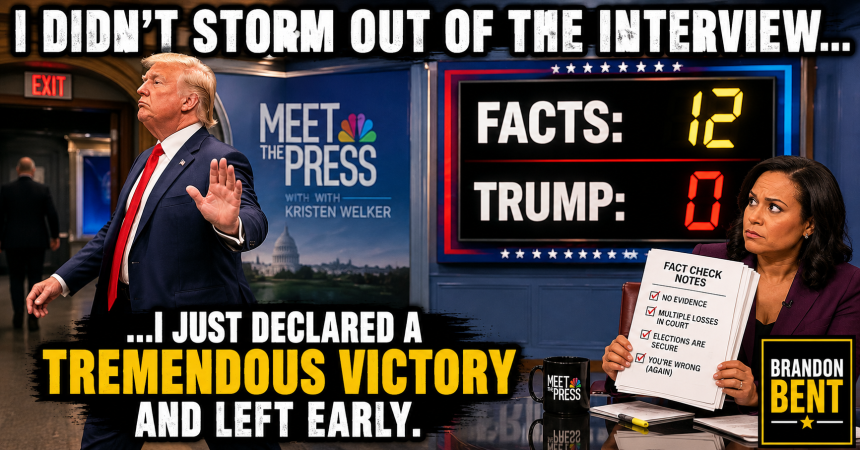
President Donald Trump abruptly cut short a tense interview on NBC’s Meet the Press Sunday after a heated exchange with moderator Kristen Welker over his continued claims regarding election fraud.
The interview, which had been promoted as a wide-ranging discussion on domestic and foreign policy issues, took a dramatic turn when Welker repeatedly challenged Trump to provide evidence supporting his allegations that recent elections, including California’s vote-counting process, were rigged. According to reports, Welker pushed back on the president’s assertions, noting that there is no verified evidence supporting widespread election fraud claims.
As the exchange intensified, Trump became visibly frustrated with the questioning. When Welker asked whether he had evidence to support his accusations, Trump responded that he only needed to “look” at the results. Welker countered that observation alone did not constitute evidence, prompting the president to launch into a broad criticism of major news organizations.
You’re a one-sided crooked network,” Trump said during the interview, before extending his criticism to several other media outlets. Moments later, he declared, “Let’s call it quits because I’ve had enough,” signaling an abrupt end to the conversation.
Welker attempted to continue the interview, reminding Trump that she had traveled to Wisconsin for the exclusive sit-down. However, the president remained unmoved, criticizing the press and arguing that media organizations were harming public trust. “A country can never be great with a dishonest press,” Trump said before leaving the interview area.
The confrontation overshadowed several other topics discussed during the interview, including the economy, interest rates, immigration, and foreign policy. Trump defended his administration’s handling of economic issues and argued that recent job growth demonstrated the strength of the U.S. economy.
The exchange quickly generated reactions across social media and the political spectrum, with supporters praising Trump for confronting what they viewed as hostile media coverage, while critics argued that the president failed to substantiate his claims when pressed for evidence.
Despite the contentious ending, Welker revealed after the broadcast that Trump later agreed to participate in a follow-up interview, suggesting that the public may soon see another round of exchanges between the two.
The dramatic conclusion marked one of the most combative moments of Trump’s recent media appearances and highlighted the continuing tensions between the president and members of the national press corps. As the 2026 political landscape continues to evolve, Sunday’s interview served as another reminder of Trump’s willingness to confront journalists directly when challenged on controversial claims and policies.